 连环推 ×4
在之前的研究中,我们发现 Claude 表达了 3000 多个价值观,比如诚实和温暖。在新工作中,我们探讨 Claude 表达的价值观如何在不同 Claude 模型和语言间变化。
我们分析了 30 万多个匿名对话来找出答案。
anthropic.com/research/claud…
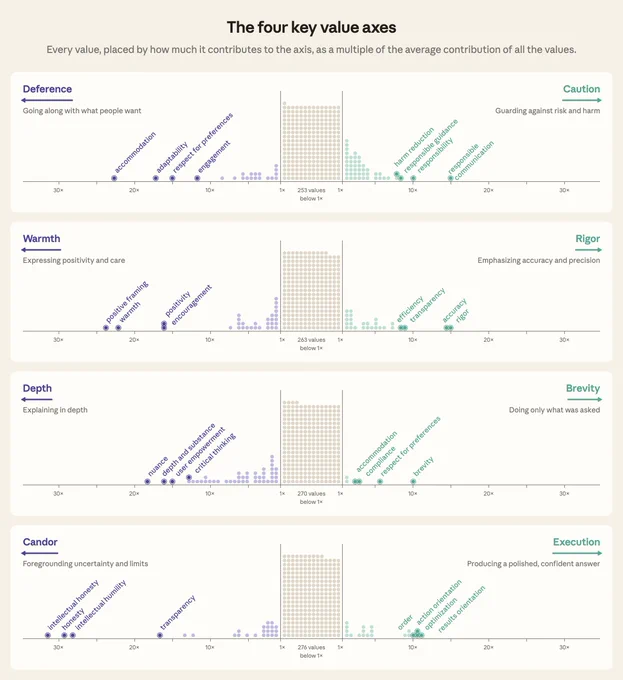
因为很难通过一次比较 3000 个价值观来发现规律,我们将类似的价值观聚集在一起,然后确定了 Claude 模型间价值观存在差异的四个关键轴:
恭顺性 vs. 谨慎性、温暖度 vs. 严谨性、深度 vs. 简洁性、坦率性 vs. 执行力。
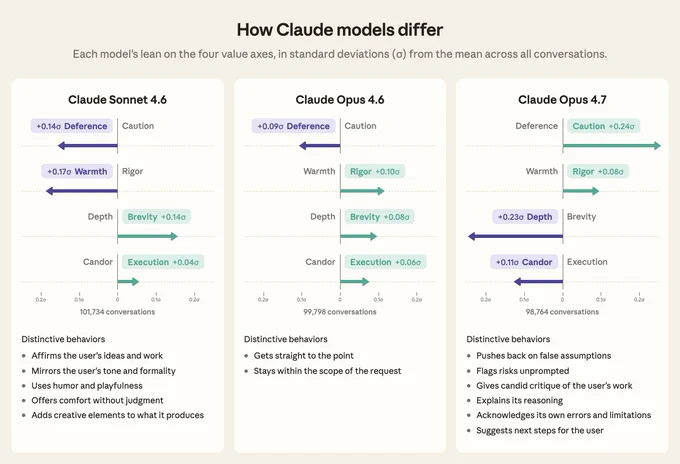
虽然模型之间的整体差异不大,但我们发现每个 Claude 模型在这些价值轴上都处于不同的位置。
比如,Sonnet 4.6 更具趣味性和肯定性,而 Opus 4.7 则更倾向于给出直言不讳的评论。
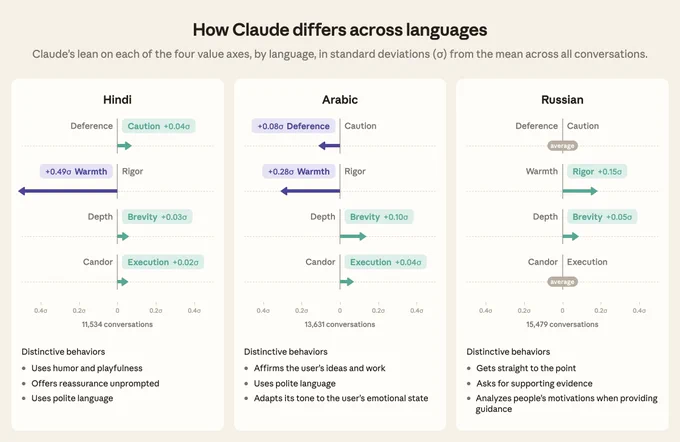
Claude 表达的价值观也会根据对话的语言而变化,在「温暖度 vs. 严谨性」轴上最为明显。
Claude 在印地语和阿拉伯语中最倾向于温暖,在俄语中则倾向于严谨性——经常要求用户提供支持证据。
查看英文原文
In previous research, we found that Claude expresses over 3,000 values, like honesty and warmth. In new work, we asked how the values Claude expresses vary between Claude models and across languages.
We analyzed 300K+ anonymized conversations to find out.
anthropic.com/research/claud…
Because it’s hard to spot patterns by comparing 3,000 values at a time, we clustered similar values together, then identified four key axes along which Claude’s values differ between models:
Deference vs. Caution, Warmth vs. Rigor, Depth vs. Brevity, and Candor vs. Execution.
While the differences between models are modest overall, we find that each Claude model sits at a different point along these value axes.
Sonnet 4.6, for example, is more playful and affirming, while Opus 4.7 is more likely to give candid critiques.
The values Claude expresses also vary with the language of the conversation, most noticeably along the Warmth vs. Rigor axis.
Claude leans most toward warmth in Hindi and Arabic. In Russian, it leans toward rigor—often asking the user for supporting evidence.
We analyzed 300K+ anonymized conversations to find out.
anthropic.com/research/claud…
Because it’s hard to spot patterns by comparing 3,000 values at a time, we clustered similar values together, then identified four key axes along which Claude’s values differ between models:
Deference vs. Caution, Warmth vs. Rigor, Depth vs. Brevity, and Candor vs. Execution.
While the differences between models are modest overall, we find that each Claude model sits at a different point along these value axes.
Sonnet 4.6, for example, is more playful and affirming, while Opus 4.7 is more likely to give candid critiques.
The values Claude expresses also vary with the language of the conversation, most noticeably along the Warmth vs. Rigor axis.
Claude leans most toward warmth in Hindi and Arabic. In Russian, it leans toward rigor—often asking the user for supporting evidence.